Cost Layer
by Item
3480 is the option to inquire into the Cost Layer of an item both open and closed layers.
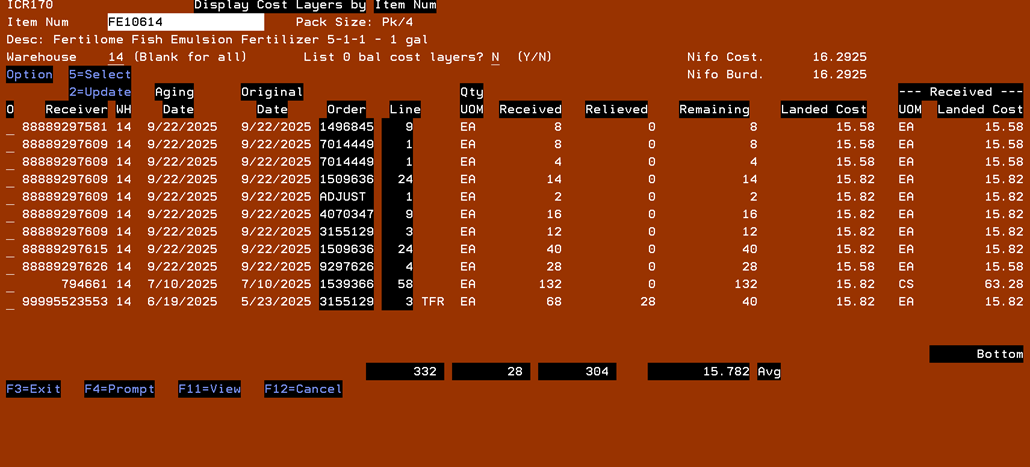
Receiver
number:
There are basically
three (3) different configurations for this number.
1.
A number without leading 8’s or 9’s. This will always denote the original receiver
number assigned at the time a Purchase order is received.
2.
A number with the leading 8’s will
indicate a return of product from a customer via the return processing
program. The format of this
number will be four (4)- 8’s
followed by the right- most 7 digits of the return invoice number. So, the
example above 88889297609,
is broken out in this
manner. 8888 indicates a return invoice,
and that number following, 9297609, will be the invoice number truncated by the
left-most digit.
In this case 19297609 would be the complete
invoice number for this cost layer.
3.
A number with the leading 9’s will indicate two possible scenarios. A Transfer received from another location or
an Inventory adjustment.
Unlike the explanation for the
layer beginning with 8’s, the number itself has no further definition. The series of numbers after the 9’s is just a
sequence number assigned at receiving time.
Aging
Date vs Original Date:
1.
The Aging date is used to age the
Locations inventory. The Original date is the date that the item was received
into our inventory.
2
A division-to-division transfer
would show different dates in the two date fields. (This is to not penalize the
receiving division for old inventory received from the shipping division.)
3
The division-to-branch date fields
will be kept the same as the originating shipping location.
4
The Aging Date and the Original Date will
be the same on the Original Purchase Order Receivers. This will be the date the product was received.
5
The Aging Date and the Original Date will
be same on returns and will reflect the date the return was processed into the system.
Order and
Line:
1.
The Order number for a Purchase Order receiver, will be the Purchase Order number that is actually received.
2.
The Order number for a transfer will be
the truncated transfer number. (The
left-most digit being truncated)
3.
The Order number for a return will be the
Original Po number/Transfer number/Adjustment code from the layer(s) the
Original Order was shipped out from.
4.
The Order number with the words “ADJUST”,”FixAdj” indicate they originated
from an inventory adjustment or cost layer adjustment.